
Programming Languages: Why SQL Still Rules the Data Room
From relational roots to distributed cloud clusters — the language that outlived every data revolution.

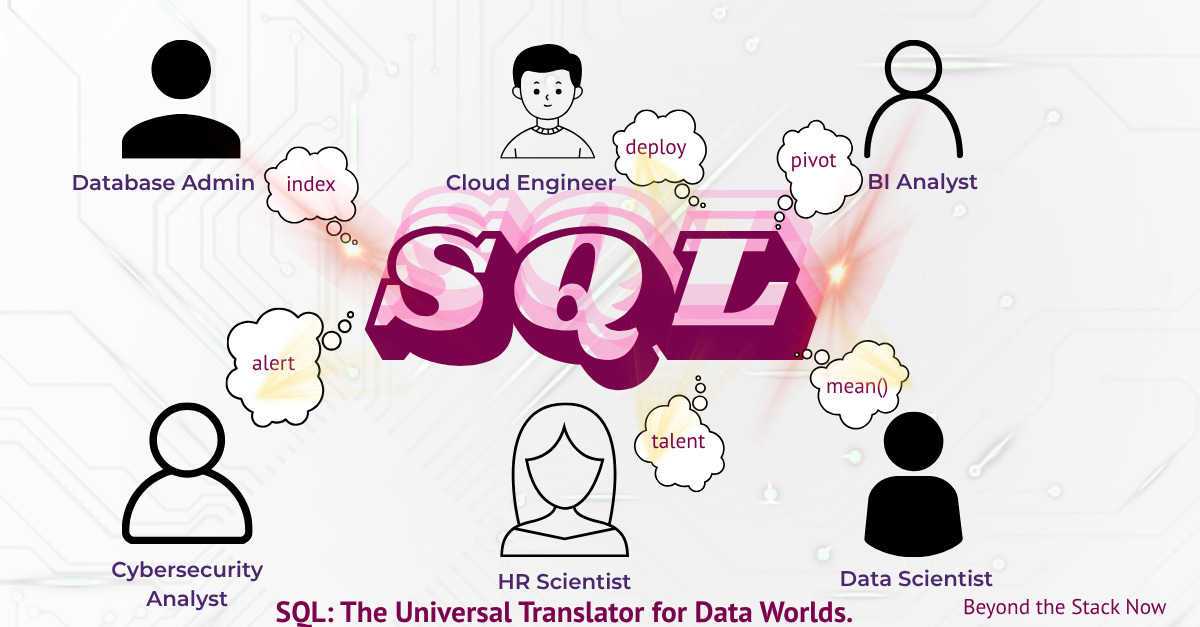
Welcome to this week’s edition of Beyond the Stack now— where we explore the ideas that quietly power modern systems.
There’s a viral image making rounds in the data world: a roundtable where everyone, from Data Analysts to Cloud Engineers, holds a baton connecting to a single word at the center — SQL. It’s humorous but true. No matter how fragmented our tools or titles grow, SQL remains the universal language that unites us all.
Just four days ago, I shared a deep dive on distributed systems that got a surprising nod from CockroachDB’s APAC head: “This explains distributed SQL better than I could.” And I received a special shoutout in LinkedIn from Senior Manager as well. When experts validate your work, you know you’re telling the right story.

They were referring to my recent deep dive on distributed systems, and their words stuck with me.
This week’s Beyond the Stack Now uncovers why SQL — the language at the heart of every data revolution — continues to unite us all, from backend engineers and data scientists to cloud architects and machine learning teams.
When did you first realize SQL connects us all? Drop your moment in the comments or reply to this email and join the roundtable!
The Roundtable of Data
Imagine a scene making waves throughout the data world: a table where every role, from Data Analyst to Cloud Engineer, holds onto a baton that leads directly to a single word inscribed at its heart — SQL. It seems lighthearted, even comical, but in truth it reflects the glue that binds together decades of innovation, turmoil, and progress. No matter how fragmented our tools and titles become, there’s a universal connector: SQL is the shared dialect that transcends generations of systems and organizations.
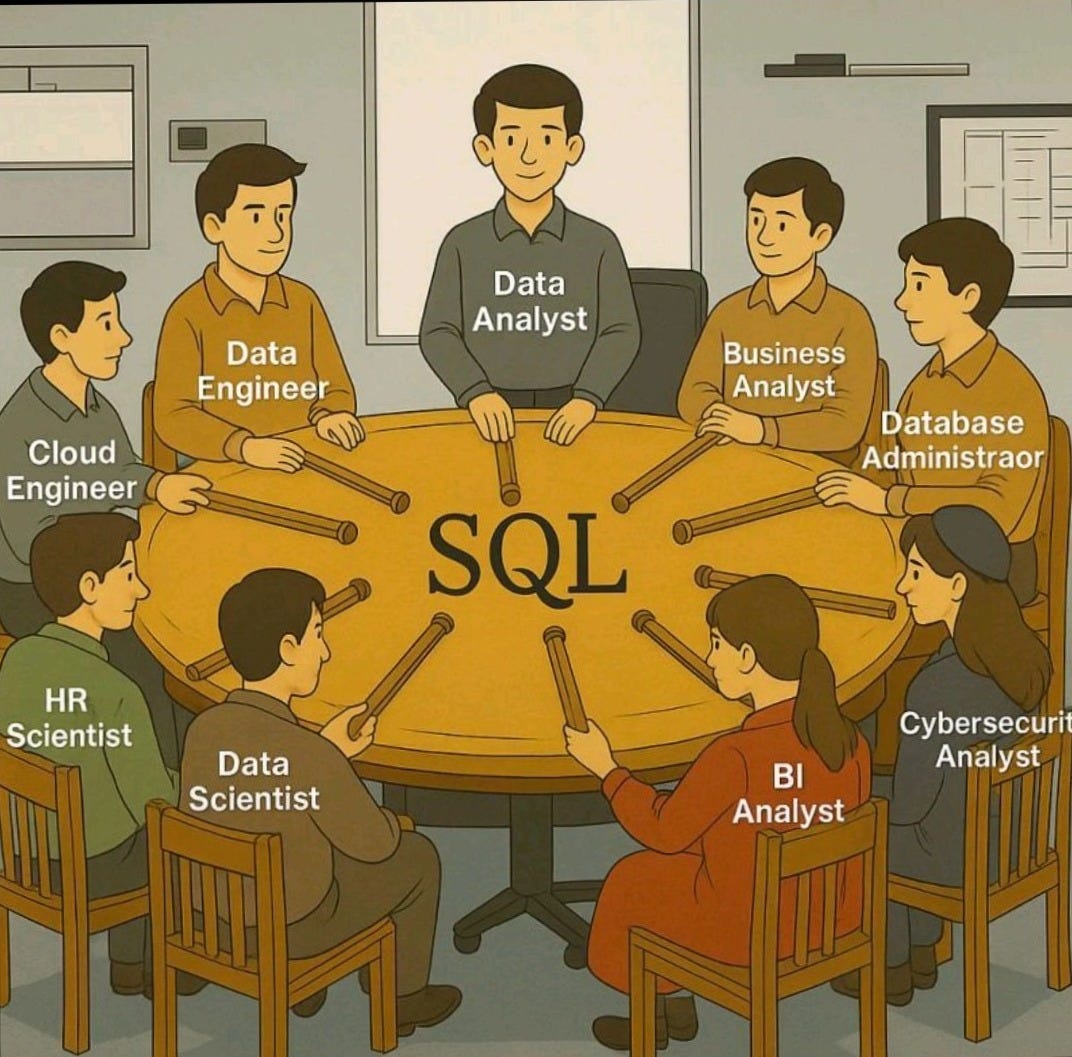
From Data Scientists and BI Analysts to Cybersecurity Experts and Cloud Engineers — everyone who touches data eventually reaches for SQL.
SQL is not just a query language; it’s the universal protocol of trust.
Every SELECT, JOIN, and WHERE is a handshake across systems — grounded in the same principles that make SQL timeless: determinism, consistency, and idempotency.
SQL’s Declarative Roots
Let’s rewind to the 1970s. Dr. E.F. Codd’s relational model didn’t just invent a new way to store data — it gifted us a logic-first approach, where structure and integrity trumped messiness and ambiguity. With SQL 1.0, concepts like uniqueness constraints, primary and foreign keys, and atomic transactions weren’t just afterthoughts. They formed the DNA of a language built to withstand chaos:
Uniqueness constraints meant every record could safely stand alone.
Referential integrity used keys to tie information into meaningful webs.
Transactional atomicity said, “all or nothing,” sheltering us from unpredictable outcomes.
Idempotency made sure repeating queries didn’t break reality.
Even today,
distributed systems crave these qualities — predictability, reproducibility, self-healing resilience.
SQL Becomes a Titan
Through the 80s and 90s, SQL underwent an enterprise upgrade. Standards like SQL-86 and SQL-92 expanded what could be expressed. Stored procedures, CHECK constraints, and powerful indexes fortified the walls of integrity and performance. Normalization became the earliest form of deduplication — reducing redundancy while preserving meaning.
SQL taught us a hard lesson:
scaling integrity only happens when discipline is enforced.
SQL Meets the Web
When the internet detonated in the 2000s, SQL was everywhere. Behind every login, purchase, and money transfer sat SQL, the unseen sentinel ensuring that your data survived every concurrent API burst or mistyped form submission. Relational databases like MySQL and PostgreSQL thrived, providing reliability, transactional integrity, and fast query processing for interactive web applications.
Idempotency became a secret superhero, taming retries and failures into a single, true outcome.
Each SELECT, INSERT, or UPDATE operation carried the promise of predictability and correctness, no matter how chaotic the internet became.
SQL wasn’t just the backend — it was the safety net for a chaotic internet.
The NoSQL Wave: Disruption — and Rediscovery
Suddenly, databases shed their schemas in favor of breathtaking speed.
Distributed Systems and Raft Consensus declared, “Let’s make data flexible!”. That’s how NoSQL emerged and became very popular. But cracks soon appeared:
Duplicates spread unchecked, lacking uniqueness constraints.
Retries created confusion, missing the promise of idempotency.
“Eventual consistency” made transactions a game of telephone.
The market responded by bringing SQL-like querying back into NoSQL databases. Today, nearly every major NoSQL product — from Cassandra’s CQL to Couchbase’s N1QL, Cosmos DB’s SQL-like dialect, and Oracle NoSQL’s hybrid support — offers familiar syntax, declarative queries, and some support for joins and aggregations.
NoSQL, therefore, has become “Not Only SQL”: combining the best of flexibility with the discipline and universality of SQL syntax. SQL endured because its roots — declarative logic, deterministic filtering, and predictable outcomes — remained essential for trust and clarity at scale.
The lesson from the NoSQL era is clear:
syntax evolves, but foundational philosophies persist — and SQL continues to anchor that reality.
Distributed SQL: The Cloud Rebellion
The emergence of distributed SQL databases such as CockroachDB, YugabyteDB, and Google Spanner marked a transformative leap for data architecture, marrying SQL’s trusted semantics to the needs of global cloud infrastructure. These databases introduced innovations to address geographic distribution, high availability, and consistent correctness at planetary scale, unifying what decades of traditional SQL solutions offered with modern cloud agility.
They combined the old with the new:
Unique indexes enforce global uniqueness across clusters.
Hybrid Logical Clocks (HLC) and TrueTime guarantee temporal correctness.
Idempotent writes and deduplication ensure exactly-once behavior across regions.
The new creed in distributed SQL is clear: scale horizontally, support transactional consistency across locations, and never surrender the traditional ACID properties that have kept SQL reliable for decades. This new breed of database is proof that modern systems can keep speaking SQL — preserving its language and philosophy — while conquering the challenges of the cloud era.
“Scale horizontally without surrendering ACID — and keep speaking SQL.”
Are you working with distributed or cloud SQL today? Share your top challenge—or your favorite SQL power hack—in the comments. Practical examples welcome!
SQL Powers Cloud Analytics
As analytics workloads migrated to elastic and serverless cloud platforms, SQL not only adapted — it thrived. Platforms like Snowflake, Google BigQuery, and Amazon Redshift have reimagined SQL for the age of petabyte-scale analytics, supporting rapid querying, concurrency, and massive throughput in ways that were impossible on legacy infrastructure.
These modern cloud data warehouses offer:
Advanced SQL features such as window functions, Common Table Expressions (CTEs), MERGE statements, and more — all for handling complex transformations and analytics seamlessly at scale.
Deduplication at scale using syntax like DISTINCT and analytical functions such as ROW_NUMBER(), which are now central to best practices in cloud data engineering.
Elasticity and parallelism: BigQuery is serverless, offering real-time analytics; Snowflake separates compute and storage for high concurrency; Redshift uses massively parallel processing for large datasets.
SQL proved again: syntax may evolve, semantics endure.
The AI Era: Declarative Meets Generative
In the today’s AI era, SQL plays a vital role at every layer of the machine learning and data science stack—from curating high-quality features to enabling large language models (LLMs) to interact with structured information. Modern AI pipelines use SQL for extracting and transforming feature sets, orchestrating reliable filtering, deduplication, and joins with the same precision that underpins classic analytics.
LLMs and other generative AI tools now commonly generate SQL queries dynamically to retrieve, filter, and aggregate information needed for intelligent responses or context-aware prompts. With the rise of vector databases and SQL extensions like pgvector, the language of SQL has expanded: it now supports similarity search, contextual and semantic querying, and retrieval-augmented generation (RAG) workflows that blend structured and unstructured data into smarter AI applications.
This convergence signals a powerful reality: declarative logic (SQL) anchors trustworthiness and data hygiene for AI/ML, while generative models interpret, extend, and execute queries to unlock new kinds of insights.
SQL’s core architecture has never been more essential, proving that as the data world innovates, its languages must endure.
Declarative meets generative — and SQL still anchors the truth.
Why SQL Refuses to Fade
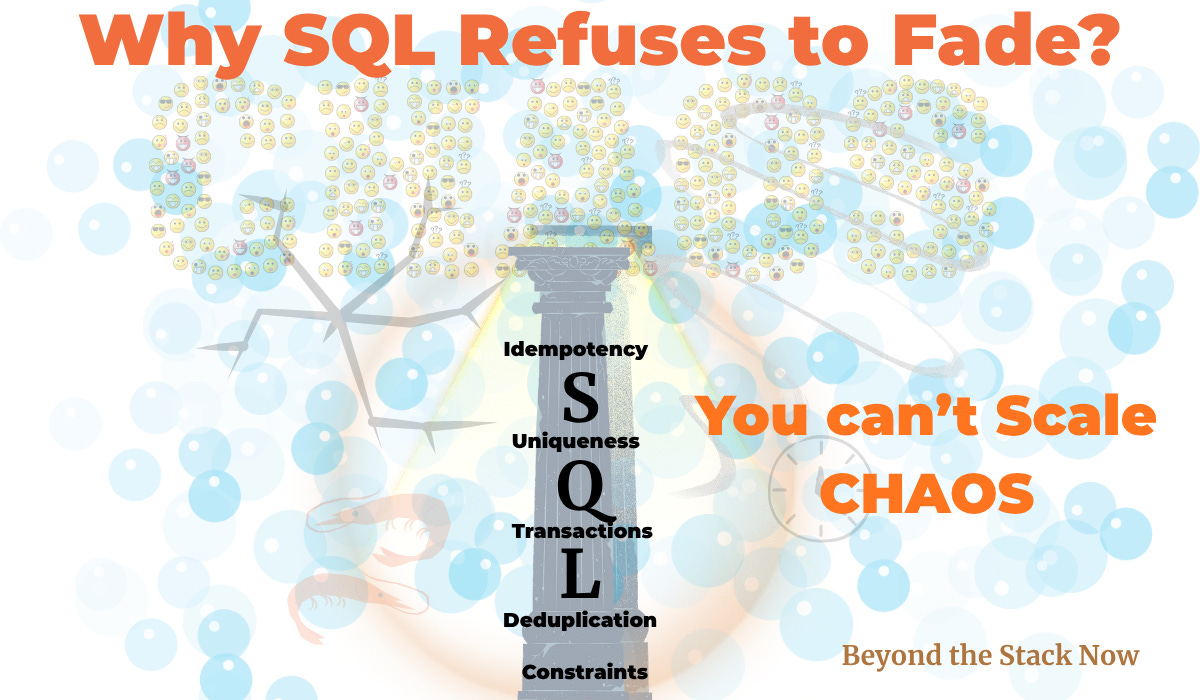
SQL has outlived every hype cycle because it’s not a technology — it’s a philosophy of correctness.
Idempotency → Safe retries, predictable outcomes
Uniqueness → One truth per entity
Deduplication → Structure over chaos
Transactions → Trustworthy state transitions
Constraints → Built-in discipline
In a world obsessed with speed, SQL still whispers the same advice:
“You can’t scale chaos.”
Which SQL core principle—idempotency, uniqueness, transactions, constraints, or deduplication—has been your North Star? Vote in the poll or leave a line on why it matters most to you!
Every Revolution, Rediscovered
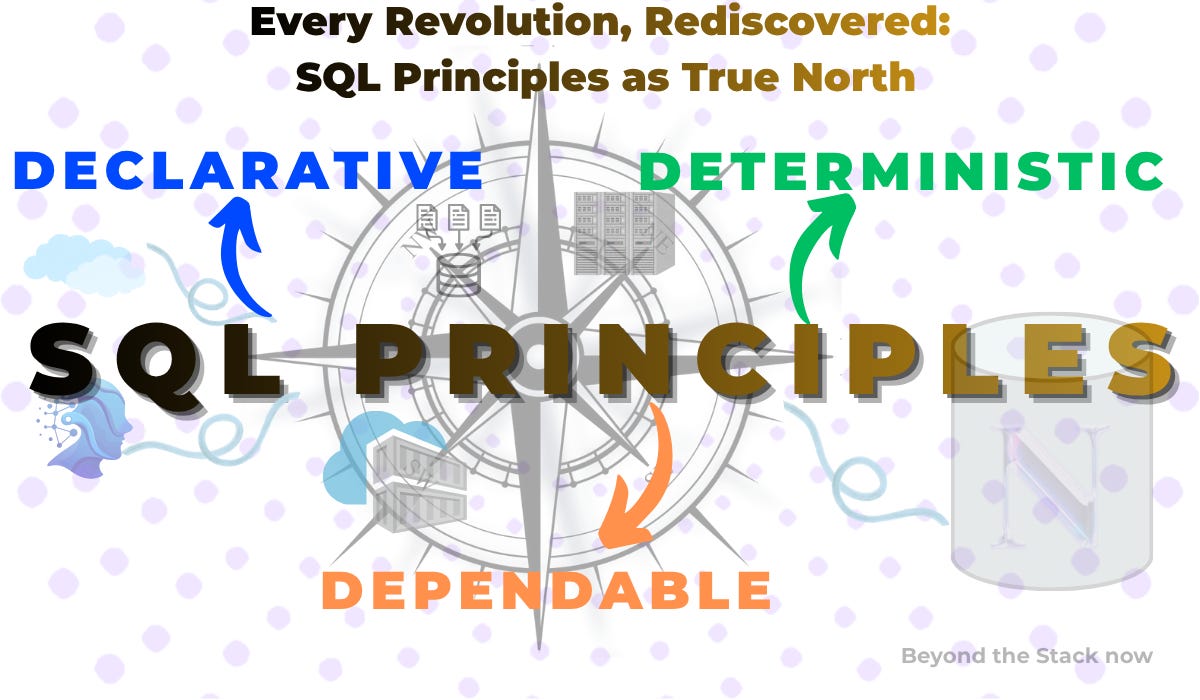
Every leap in data technology — whether it be NoSQL, cloud databases, analytics innovations, or AI-driven tools — begins by breaking SQL’s rules… but matures by rediscovering the foundational principles of SQL that continue to prove essential: Declarative, Deterministic, Dependable principles.
The roundtable never really left. Mainframes, Kubernetes clusters, real-time streams: SQL still rules the data room with its principles:
SQL’s Declarative nature means you specify what you want, not how to get it, enabling consistent results regardless of system changes or execution order.
Deterministic functions and queries always produce the same output for the same inputs, which builds predictability and trust in complex workflows.
Dependability arises from robust constraints, transaction controls, and idempotency, ensuring data integrity and resilience even amid failures or retries.
Beyond the Stack Takeaway
SQL isn’t outdated — it’s proven.
Born of academic rigor, matured in enterprise crucibles, and now thriving in distributed and AI-powered ecosystems, SQL remains the oldest living language of truth in computing.
As data systems evolve into distributed clouds and AI-infused environments, SQL’s core principles continue to anchor understanding, ensure clarity, and provide sanity in a complex technical landscape.
Next time you write a query, remember: you’re joining the roundtable that every generation returns to for sanity, clarity, and correctness.
Your Turn
Which SQL principle—idempotency, transactions, constraints, or perhaps another foundational idea—has most influenced your data work and stood the test of time? Share your thoughts and join the conversation to help keep this vibrant roundtable growing and learning together.
Enjoyed this edition? Forward it to a teammate or data friend!
Subscribe for next week’s insights—and if you gained value, tap the ♥️ or leave a comment to fuel future deep dives.
This enduring dialogue shows that SQL is not just a legacy language but a living framework continually rediscovered and enriched by each generation of technologists.
Let’s keep the SQL roundtable vibrant and growing — together.
Series note
This article is part of my Programming Languages series, where I explore how languages evolve, why myths persist, and what actually matters in real-world systems.
Read next →
Explore the full Programming Languages series
https://beyondthestacknow.substack.com/t/programming-languages
Well articulated Pradeep!
Beyond the strong validation you received wanted to highlight python’s odbc/pyodbc bridge used for interfacing with SQL across diverse database systems.