
Programming Languages: Myth #1: JavaScript Is Part of Java
If JavaScript Isn’t Java, Why Does the Name Still Confuse Millions?

“JavaScript is part of Java, basically a scripting language for Java.”
That’s what a senior colleague told me recently.
I paused.
Because this wasn’t the first time I’d heard it.
Then I did something simple and far more revealing:
I asked the internet.
I posted just one question:
“JavaScript – a part of Java?”
No explanation.
No hints.
No opinion.
What followed was revealing.
“Know a dev still mixing up Java and JS? Tag them now 👇, let’s end this myth together.”
Series note:
This article is part of my Programming Languages series, where I explore how languages evolve, why myths persist, and what actually matters in real-world systems.
See all my articles in this Series: https://beyondthestacknow.substack.com/t/programming-languages
The Internet Responded (Loudly)
In less than a day, the post crossed 2.7k views and attracted 40+ comments.
Some replies were blunt.
Some were sarcastic.
Some were deeply nuanced.
And almost all of them agreed on one thing.
This confusion is far more common than we like to admit.
And it exists not because developers are careless but because history, marketing, and teaching shortcuts collided.
Where the Confusion Begins
Let’s start with what most people intuitively assume.
Java came first
JavaScript has “Java” in the name.
Both are often taught together as “full stack.”
So the mental shortcut becomes:
JavaScript must be related to Java.
That assumption feels reasonable.
It’s also wrong.
A Name That Outlived Its Context
One of the most repeated clarifications in the discussion was this:
JavaScript was never meant to be Java.
Its original name wasn’t even JavaScript.
It started as Mocha, then LiveScript.
The rename happened in the mid-90s, when:
Java was hugely popular.
Browsers wanted credibility
Marketing wanted an association.
So LiveScript became JavaScript.
Not because of shared internals.
Not because of shared lineage.
But because Java was a powerful brand.
That decision aged badly. It stuck.
What's your wildest language myth? Drop it in comments - top ones fuel Myth #3
“But Weren’t They Connected at Some Point?”
This is where the conversation got interesting and more mature.
Because the truth is slightly more nuanced than a simple “no.”
Some commenters pointed out something subtle but important:
Early JavaScript was designed to coexist with Java, especially in browsers.
Java applets ran in browsers.
JavaScript could interact with them.
JavaScript was expected to “look like Java.”
It was positioned as a lightweight scripting companion
That explains:
Familiar syntax
Similar naming
Early documentation that mentioned Java heavily
But here’s the key distinction:
Interacting with Java does not make JavaScript part of Java.
By that logic:
SQL would be part of Java
Shell scripts would be part of Java.
JSON would be part of Java
Execution is not ownership.
Integration is not inheritance.
What JavaScript Actually Is
Once you separate history from branding, the technical reality becomes obvious.
As the discussion clarified repeatedly:
JavaScript’s real identity is ECMAScript.
It is standardized independently.
It is implemented by browsers and runtimes.
It does not belong to Java or the JVM
Java and JavaScript took entirely different evolutionary paths.
Today, they solve different problems:
Java: long-running systems, servers, infrastructure
JavaScript: event-driven environments, browsers, async-heavy workflows
The shared name is historical, not architectural.
"Loving this series? Bookmark the full Programming Languages hub and join 2k+ readers busting myths."
A Note on Oracle and Trademarks (Just the Facts)
This is where legal reality diverges sharply from technical reality.
This came up multiple times, so let’s state it cleanly:
Oracle owns Java (via Sun Microsystems)
Oracle owns the JavaScript Trademark.
Oracle does not own the JavaScript language.
JavaScript is standardized as ECMAScript, independent of Oracle
That’s it.
No conspiracy. No control over the language itself.
Why This Myth Still Bites
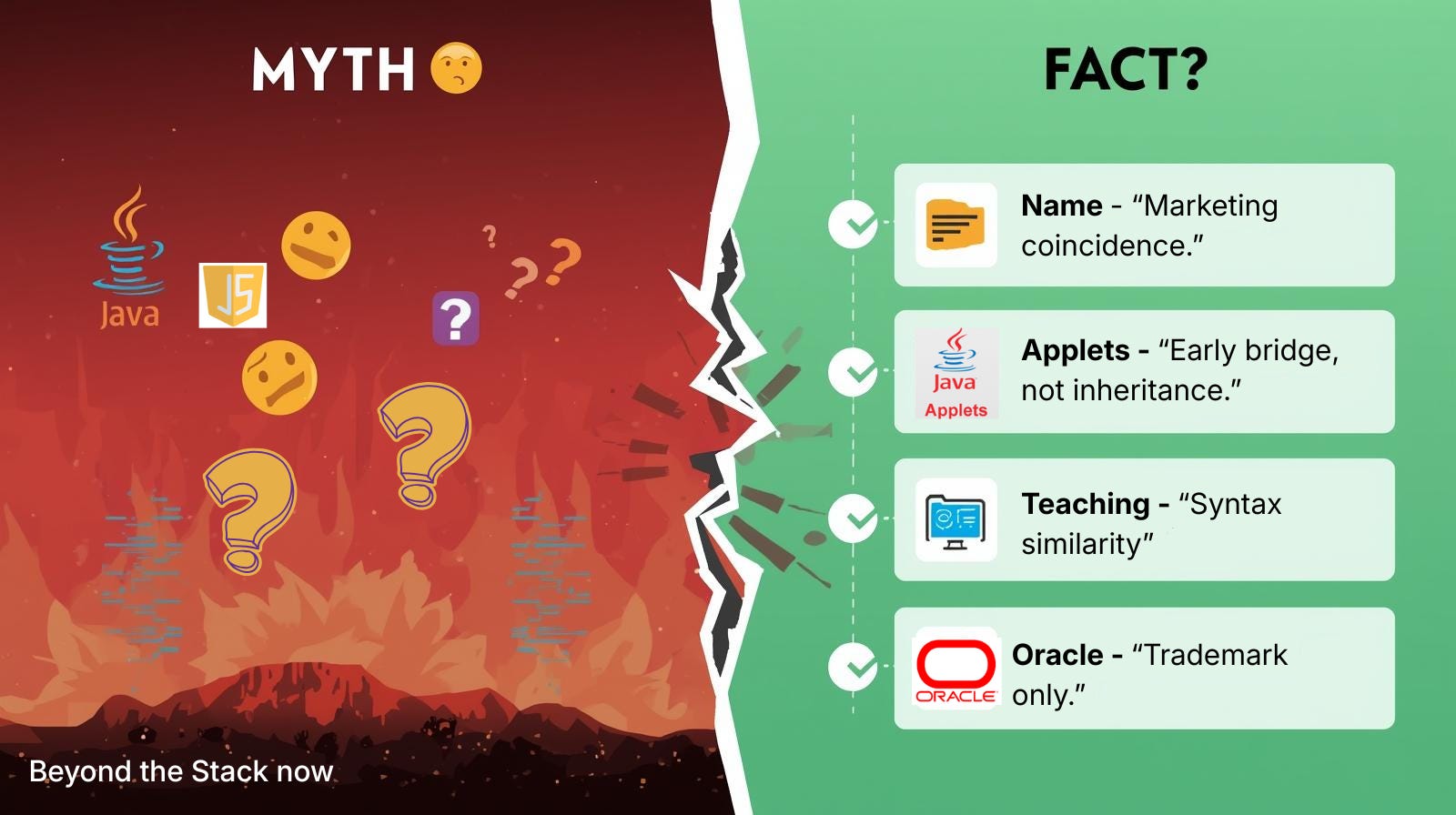
Picture a dev debugging async hell, muttering, "Why no threads like Java?" This isn't trivia industry chatter that keeps the fire alive:
Myth Fuel: Shared “Java” name / Reality Check: Marketing relic from 1995 Netscape-Sun tie-up
Myth Fuel: Browser applet era / Reality Check: Temporary LiveConnect bridge, not lineage
Myth Fuel: Full-stack teaching / Reality Check: Syntax similarity hides event-driven core
Myth Fuel: Oracle ownership / Reality Check: Trademark only; ECMA governs the evolution of JavaScript
Misunderstanding origins breeds chaos:
Wrong mental models (expecting JVM in browsers)
Poor expectations on performance and concurrency
Confusion switching ecosystems
Overconfidence from name familiarity
Skip the "why" for syntax, and myths hitch a ride with every npm install.
Which fuels your myths? Comment below.
The Real Lesson
JavaScript isn’t confused with Java because developers are lazy.
It’s confusing because:
A marketing decision outlived its context.
Education focused on tools, not origins.
The industry never corrected the story loudly enough
Once you understand the history, the confusion disappears permanently.
My Take And the Timeline That Explains Everything
Here’s my take, after reading the history and watching this myth resurface again and again:
JavaScript wasn’t named to explain its design.
It was named to ride a wave and it worked too well.
Once you walk through the timeline, the confusion stops looking naïve.
It starts looking inevitable.
The Timeline That Still Shapes the Myth
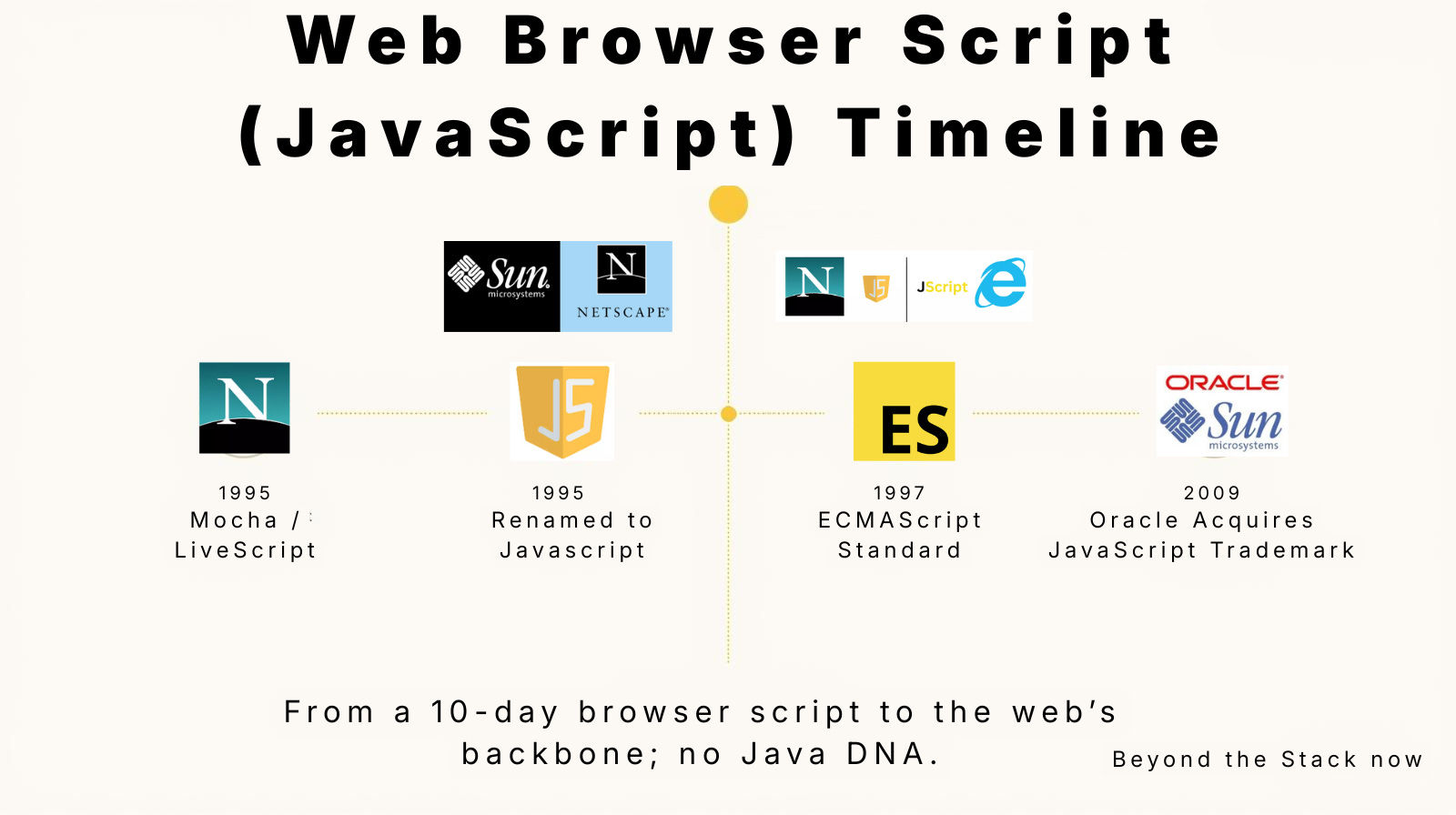
Early 1995: The Web Hits a Wall
HTML could display content, but it couldn’t react.
Browsers needed:
A lightweight scripting language
Something embedded, dynamic, and forgiving
Definitely not a heavy, compiled system language
This requirement alone already ruled Java out technically.
1995: Netscape Creates a Browser Scripting Language
At Netscape, a new scripting language was commissioned.
It was created by Brendan Eich under intense time pressure.
The design goals were clear:
Simple syntax
Dynamic behavior
Event-driven execution
Tight browser integration
Internally and philosophically, it looked nothing like Java.
1995: Mocha → LiveScript
The language was first called Mocha, then LiveScript.
At this stage:
There was no Java branding.
No implication of inheritance
Just “a scripting language for the browser.”
The confusion hadn’t started yet.
Late 1995: Java’s Popularity Changes the Name
Java was everywhere.
Sun Microsystems was heavily promoting Java applets.
Netscape and Sun had a close partnership.
“Write once, run anywhere” dominated developer mindshare.
So LiveScript was renamed:
JavaScript
Not because it was part of Java.
But because Java was the strongest technical brand of that era.
That single marketing decision created a misconception that would survive for decades.
Late 1990s: The Paths Quietly Diverge
What followed is often skipped in modern retellings:
Java moved toward servers, enterprise systems, and the JVM.
JavaScript stayed in the browser.
Java applets faded away.
JavaScript became unavoidable
The technical connection disappeared.
Only the name remained.
1997 Onward: JavaScript Leaves Java Behind
To prevent fragmentation, JavaScript was standardized as ECMAScript.
From that point:
The language evolved independently.
Multiple engines implemented it.
Java had no role in its governance
JavaScript’s future was no longer tied to Java, even indirectly.
"Building full-stack? Share your Java-to-JS switch horror stories below. (Pro tip: Event loops await.)"
2009: The Name Changes Hands, Not Meaning
When Oracle acquired Sun Microsystems, it also acquired the JavaScript trademark.
This added another layer of confusion:
Oracle owns the name “JavaScript.”
Oracle does not define the language.
The specification remains with ECMA.
Once again: ownership of a name, not ownership of a design.
My Opinion (With Hindsight)
The myth persists because the name outlived its original context.
In the 1990s:
The name helped with adoption.
The association felt natural.
The web was experimental.
Today:
The context is gone
The name misleads
The myth survives through habit and teaching shortcuts
And because we teach frameworks before fundamentals,
The story behind the language quietly disappears.
One Line That Ends the Confusion
If there’s one sentence worth remembering:
JavaScript was designed near Java, branded with Java, but never built from Java.
Once you understand that, the myth doesn’t just fade; it collapses.
Closing Thought
Names shape how we think. Bad ones birth myths that outlive their time.
This is Myth #1 in my Programming Languages series.
Myth #1: Busted. Now you?
❤️ if this cleared your JavaScript fog!
💬 Comment your next language myth request below.
🔄 Restack to free one dev from the JavaScript=Java trap.
Share with a confused colleague or with one dev trapped in the JavaScript=Java trap.
In the next one, I’ll pick another belief we casually accept and ask whether it actually holds up. Subscribe so that you don’t miss the next one.
Series note
This article is part of my Programming Languages series, where I explore how languages evolve, why myths persist, and what actually matters in real-world systems.
Read next →
Explore the full Programming Languages series https://beyondthestacknow.substack.com/t/programming-languages