
Programming Languages: Java — Thirty Years of Staying Simple
What Java removed, and refused to add, so your code stays explainable in year ten.

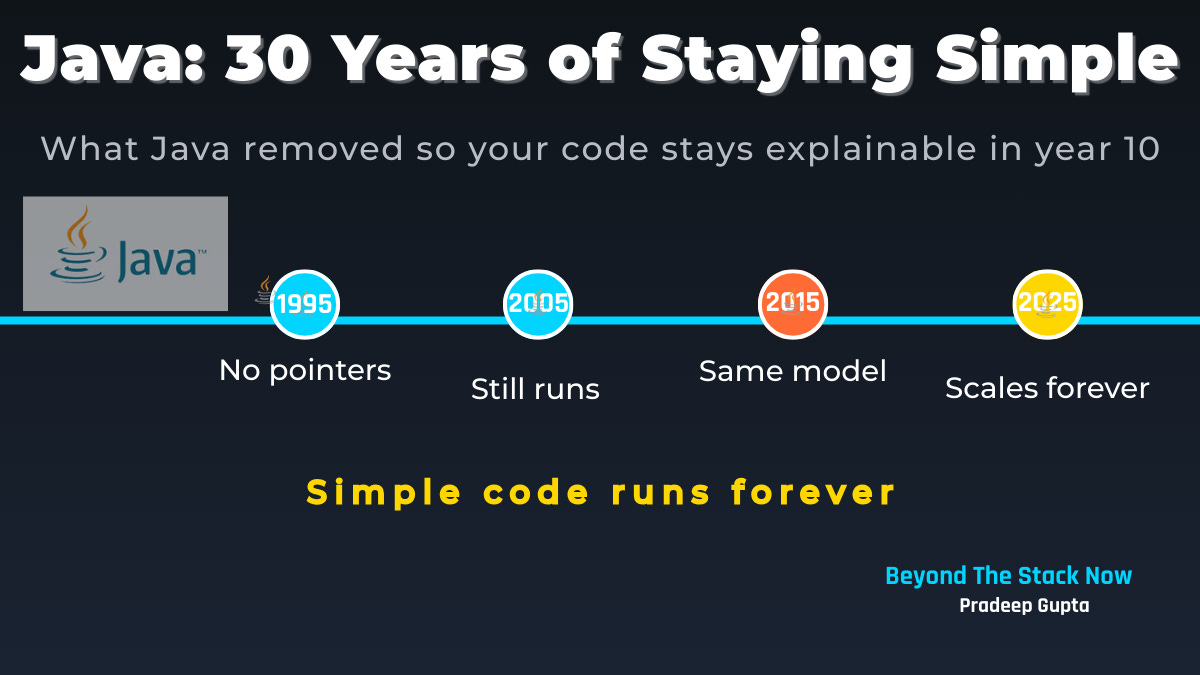
Look at what Java did not ship: no pointer arithmetic, no undefined behavior, no clever shortcuts that make debugging a guessing game.
If you want to ship fast, chase features. If you want to ship for years, choose simplicity.
For thirty years, each release quietly removed friction instead of adding magic.
The result is a language you can still teach on a whiteboard and trust in a trading system.
Programming Languages Series
This article is part of an ongoing series where I explore how programming languages evolve, why certain myths refuse to die, and what actually matters when languages meet real-world systems.
In the past, I have written for 12 Buzzwords for Java.
And Existence of Java in this AI era.
In my 20+ years of career in Java, one thing still stands out and fascinates me: How has Java managed to stay simple for so long? Let’s reveal that as we go through this journey.
Quick question: What’s the oldest Java version you still maintain in production?
Drop it in the comments—Java 7? 8? 11? 17?
I’ll feature the most interesting stories in next week’s edition.
👉 Subscribe for free to catch those + weekly deep dives on systems that scale.
700+ engineers subscribed on LinkedIn · 3.6K+ following the journey
Join the full deep dives here on Substack—weekly systems stories they don't see anywhere else.
Java’s story starts in a lab where nothing felt simple.
In the early 1990s, a small team of engineers kept losing time to the same old problems: memory leaks that crashed demos, pointer bugs that took days to trace, programs that worked on one machine and mysteriously failed on another. They were good engineers, but their tools kept punishing them for tiny mistakes. After enough late nights, a quiet question started to form:
“What if the language did more of the worrying, so developers could think more about the problem and less about the plumbing?”
That question became the seed of Java.
Three decades later, with Java 25 now generally available, the language and platform look very different on the surface, but the core promise has not moved:
Java’s greatest strength is still its simplicity.
The interesting question is not “what’s new,” but “how did it stay this way for so long?
The Day Java Chose “Less, But Trustworthy”
You can almost picture the early design meetings: they were not mainly about what to add, but about what to remove.
Pointers were powerful, but one bad arithmetic step could corrupt an entire process.
Manual memory management gave control, but also leaks, double frees, and crashes at random times.
Platform-specific binaries ran fast, but broke every time you changed machines.
They went down the list:
No pointer arithmetic.
No manual memory release.
No platform-specific binaries.
No header files.
No undefined behavior.
Then came Java 1.0.
On the surface, it still looked familiar; class, if, for, methods, exceptions. Underneath, everything important had changed.
The compiler now produces bytecode for a virtual machine.
The runtime verified the bytecode before running it.
Code allocated objects and let the runtime decide when to reclaim them.
Developers did something simple: they wrote tiny programs, a small GUI, a network tool, and noticed that when things broke, it was almost always their logic, not some invisible, undefined corner of the language. For the first time, many felt:
“I can focus on what I want the program to do, not how the machine might betray me.”
Java’s simplicity started as an act of refusal, removing the sharp edges, and turned into a contract of trust: if your code compiles and looks reasonable, it will behave reasonably.
That feeling—trust—is where simplicity begins.
Java Grows Up, But Doesn’t Grow Wild
Years passed. Java spread from applets in browsers to big application servers and production backends. Banks, telcos, retailers, and startups all piled in. With that came pressure.
“Add more features.”
“Make it more expressive.”
“Let me do this shorter, smarter, faster.”
Most languages, under that pressure, grow sideways. New paradigms arrive like layers of sediment; code written in different eras feels like different dialects. Reading a 10-year-old codebase becomes archeology.
Java took a slower, more disciplined path.
a. Backward Compatibility as a Simplicity Tool
From Java 1.0 to Java 25:
Old code still runs
Concepts accumulate slowly
Breaking changes are rare
This matters more than it sounds.
Simplicity isn’t just about syntax.
It’s about not having to relearn everything every few years.
Java allows you to:
Read old code confidently
Upgrade systems incrementally
Carry mental models forward
That continuity is a form of simplicity.
b. Explicit Over Clever
Java has always favored:
Clear structure
Explicit intent
Predictable behavior
Even when new features were added, they followed existing patterns instead of inventing new mental models.
When Java added:
Better abstractions
Improved type handling
Cleaner syntax
It did so without changing how programs fundamentally behave.
Nothing magical happens behind the scenes.
What you read is what executes.
That predictability reduces cognitive load—especially in large systems.
c. Complexity Is Opt-In
One of Java’s underrated design choices is this:
You can write simple code forever.
You are never forced to adopt advanced features.
From Java 1.0 to Java 25:
A basic class still looks familiar
A simple loop still behaves the same
Core ideas remain unchanged
Advanced constructs exist—but only when you choose them.
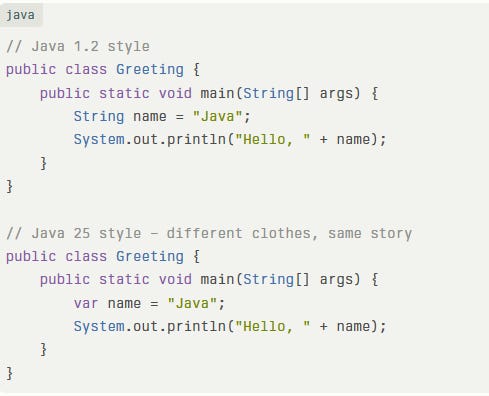
The surface changed a little (
varinstead of an explicit type), but the way you read and reason about this code has stayed simple for 30 years.
A senior engineer, like me, who learned Java around 1.2 could walk into a Java 8 codebase, blink at some new syntax, and very quickly say, “Okay, I see what this does.”
The runtime changed; the mental model did not.
That was not an accident. It was the plan.
The Architect’s Quiet Deal With Java
Somewhere around the mid-2000s, something interesting happened in big companies.
Architects sat in design reviews and asked the same questions:
“Will we understand this system in five years?”
“Can a new team debug this at 2 a.m.?”
“Will a small change break everything?”
In those rooms, Java had an unfair advantage.
It was familiar enough to most engineers that ramp-up time was short.
The behavior of basic constructs had been stable for years.
Tools—profilers, debuggers, loggers—spoke the same language as the runtime.
Even when the ecosystem around Java shifted—new frameworks, new build tools, new ways of structuring services—one thing stayed constant: you could draw a simple diagram of how a request flowed through Java code, where errors surfaced, how threads behaved, and it was still accurate over the years.
That stability made it easier to reason about enormous systems.
The language was not just a tool for writing code; it was a stable surface for thinking.
The Boring Language In The War Room
Now, picture a production incident.
It is 2:37 a.m. Logs are scrolling on one screen, a metrics dashboard glows red on another, and a small group of sleepy engineers huddle on a call. Somewhere in the mess is a failing service written in Java.
What happens next is revealing.
A senior engineer pulls up the logs, then the code. They follow the stack trace, which includes method calls, classes, and line numbers. They read the flow and say something like, “The request hits this controller, calls this service, which calls this repository, which is timing out on this downstream dependency.”
None of this is glamorous. It is not a demo of cutting-edge syntax. But it is exactly what matters: the ability to reconstruct what is happening quickly, under pressure, by reading code that behaves as it looks.
In that moment, Java’s “boring” nature is a gift.
No hidden magic. No surprise rewrites at runtime.
Just code, running pretty much how you imagine it.
If Java's "boring" stability saved your on-call night, hit ❤️ + share this with your team.
Architects: What's your "Java war story"?
- The monolith that wouldn't die?
- The 2 a.m. stack trace that actually made sense?
Top 3 stories get:
✅ Personal shoutout in next edition
✅ My "Simple vs Clever" checklist (5-min PDF)
✅ Early access to next Java deep dive
👉 Loved this? Forward to 3 engineers who need to hear it.
Simplicity Is A Long Game
Simplicity is often misunderstood as “having fewer things.” In practice, simplicity is about having fewer surprises.
Java today clearly does not have fewer things. Java today has:
Rich abstractions
Strong typing
Modern syntax
Extensive libraries
But the way those things are organized respects a few quiet rules:
New ideas layer on top of old ones instead of replacing them.
Similar-looking constructs behave in similar ways.
Defaults aim to be safe first, tunable later.
Important behavior tends to be explicit in the code, not hidden behind unseen machinery.
Java doesn’t ask developers to remember dozens of special cases. It asks them to understand a small set of principles deeply, and it rewards them for mastering fundamentals.
That is what makes it feel like a long-distance runner’s tool: it may not sprint the flashiest laps, but it keeps going, mile after mile, without breaking your stride. That’s real simplicity.
20+ years building resilient systems taught me one thing:
Simplicity compounds like interest—but only if you spot career breakpoints early
My new e-book “Breakpoints of a Career” decodes my career breakpoints (and helps you to identify yours):
Job offer yanked before day 1
Buffer failed while inactive
XML generates its own Java code
The MARS discomfort I accepted
Spike that taught real resilience
An AI agent that felt alive
Subscribers get an instant discount.
Already read? Comment “BREAKPOINTS” → you will be featured in my next edition’s “Reader Stories”.
The Road Ahead: Evolving Without Losing Its Soul
Looking ahead, Java’s future is not about reinvention. It’s about:
Removing friction
Reducing noise
Improving clarity
Preserving trust
The language has proven something rare in software:
You can evolve for decades without losing your soul.
Java’s simplicity is not accidental.
It is the result of discipline, restraint, and respect for developers’ time.
If you want to impress today, make it clever.
If you want it to last, make it simple.
Java's secret isn't power. It's the discipline to stay simple for 30 years.

Tag 2 architects who, you think, need this mental model.
Quote tweet: "Java's real superpower: code from 1998 still runs on Java 25. Here's why."


Final Thought
Four quick actions if this hit home:
1️⃣ Subscribe (free) → Weekly: Java, systems, architecture deep dives
2️⃣ Comment your Java version → Featured in next edition
3️⃣ Share → Architects need this mental model
4️⃣ Grab “Breakpoints of a Career” → instant discount for readers [Link]
Goal: 1M reads. You’re helping make it happen.
For three decades, Java has chosen as the second line. And that is why, quietly, behind so many critical systems, it is still there—still simple enough to explain, and still strong enough to run.
Java is simple, not because it lacks power. Java is simple because:
It removes unnecessary choices
It protects mental models
It values clarity over cleverness
It evolves without breaking trust
That’s why Java has lasted from 1.0 to 25—and why it will continue far beyond.
Simplicity, when done right, scales.
And Java is living proof.
Series Note
This article is part of my Programming Languages series, where I explore how languages evolve, why myths persist, and what actually matters in real-world systems.
Read next
→
Explore the full Programming Languages series
https://beyondthestacknow.substack.com/t/programming-languages