
Designing for Chaos: How CockroachDB’s DNA Rewires Your Application Mindset for Resilience
What if your database didn’t just survive disasters but rewired the way you design apps for the unpredictable? Let’s unravel CockroachDB’s secrets.

Imagine watching a cockroach survive 47 disastrous events—node crashes, network splits, data center blackouts—and barely flinch. This is not luck, but the art of resilience deeply engineered.
Missed the last deep dive on Resiliency of CockroachDB, a leading distributed SQL database that built for global scale? Catch up here before continuing.
But a resilient database isn’t just an insurance policy—it’s a blueprint.
What if you start your design, not by just assuming the database will “be fine,” but by collaborating with it? Let’s unravel how CockroachDB’s battle-tested principles shape your app design—if you read closely.
Top 5 Principles of CockroachDB
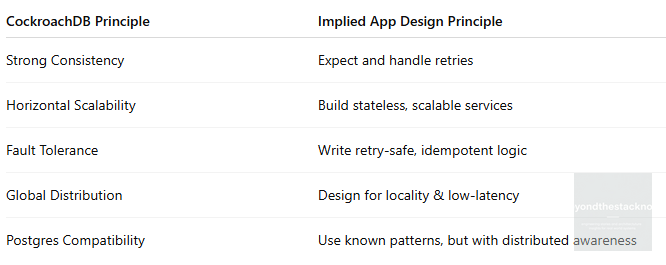
1. Embrace Failure, Expect Retries: Write Like the World Can Change Anytime
Transactions in CockroachDB are like a tightly choreographed dance; every step must be agreed upon by all performers before the scene can move forward. If a step falters, the dance repeats—but never skips a beat.
CockroachDB enforces strong transactional consistency, turning every write into a mini-consensus event across the cluster. As previously discussed, CockroachDB ensures strong consistency in distributed transaction management (underlying KV Store) using Hybrid Logical Clocks (HLC) + Commit Wait time and Epoch based retries.
Although CockroachDB ensures strong consistency, as app designers, we must embrace that failures will happen, and successful transactions might not go through on the first try.
So, rethink your happy path. When you create an order or update inventory, always expect and gracefully handle retries. Imagine a checkout flow where, mid-way, a blip occurs. The logic must ensure that a user never gets double-charged because their retrying transaction was duplicated.
🔄 How does your team handle retries and idempotency in critical systems? Share your strategies or war stories in the comments!
Idempotency isn’t just smart; it’s survival.
2. Jazz Ensemble Architecture: Stateless for Infinite Horizons
Picture your backend as a jazz ensemble, not a symphony. In jazz, musicians come and go, solos emerge, and anyone can pick up the melody without missing a beat. That’s how stateless micro-services work.
Each service instance can be replaced, multiplied, or killed off, and the music—your application—never stops.
CockroachDB is a geo-distributed SQL database (Cloud-Native Database) built for seamless, horizontal growth. By “distributed,” it means not only the ability to add database nodes on demand—from Mumbai to Oregon to São Paulo—but also to withstand hardware or data center failures without interrupting service. But here’s the catch:
Horizontal Scaling is just infrastructure theater without a matching application strategy.
In order for application to adopt Jazz Ensemble Architecture (Stateless Microservices Architecture):
Store all session and transient state outside the application server. Use object stores, key-value caches like Redis, or a distributed database like CockroachDB itself.
Scale up for spikes with zero drama. When a sports event drives a sudden user surge, any instance can pick up any session, because nothing is pinned to a given server.
Avoid sticky sessions and server affinity. When instances are disposable, state should never be trapped in-process.
And there’s another vital piece: leaseholder locality. In CockroachDB, every “range” of our data has a leaseholder node responsible for serving the most up-to-date copy. The system intelligently places these leaseholders close to where the requests originate—so users in Sydney or California connect to data with minimal latency.
The result? Scaling your application—both code and data—becomes a routine act, not a night of frantic firefighting.
With each new node, the system gets stronger and your services can simply join the ensemble, riffing together in perfect sync.
🎷 Can you relate to the ‘stateless jazz ensemble’ analogy? How have you scaled your services horizontally? Let’s discuss below!
3. Built-In Safety Nets: Design for Clean Recovery
Imagine a tightrope walker crossing a wire stretched across continents. If one cable snaps, others instantly bear the load without the walker missing a step. That’s what the fault tolerance or high availability we need for our application. And CockroachDB does exactly that with the data.
In a distributed database like CockroachDB, fault tolerance isn’t an afterthought—it’s baked into the DNA. It maintains multiple copies of every piece of information (data) across different nodes, replicating data typically three times by default. If a node fails, the system automatically reroutes requests to healthy nodes that hold up-to-date replicas. This failover happens quietly and seamlessly, ensuring app never has to pause or panic.
At the heart of this magic lies the Raft consensus protocol, a quorum-based mechanism where a majority of nodes agree on the transaction state before it’s committed. This ensures data integrity and strong consistency, even amid network partitions or node crashes.
But fault tolerance is not just the database’s job—our application must play along. We should design every API and service call to be retry-safe.
Your purchase API should handle repeated requests without double-booking seats; your payment service should ignore accidental replays. This means employing idempotency keys, unique transaction tokens, or natural uniqueness constraints.
In CockroachDB’s world, failures are expected and tolerated. Your code should be equally resilient—understanding that sometimes operations must be safely retried, and building logic that never lets “ghost” transactions from yesterday’s glitch haunt our system.
With CockroachDB’s automated failover, self-healing data replication, and quorum-based consensus protecting the data, app’s fault tolerance comes alive only when the design embraces retries and idempotency as first-class citizens.
🛡️ What’s the toughest fault tolerance challenge you’ve faced in production? Tell me your story!

4. Think Local, Act Global
Your app code is like an orchestra conductor leading a global symphony. Though musicians (data nodes) are scattered worldwide, the conductor ensures every note (query) arrives as if performed locally—clear, on time, and harmonious.
CockroachDB is not just horizontally scalable—it’s geo-distributed. Geo-partitioning is the sheet music dividing parts by region—each musician plays their part closest to home for the best sound. That means our data lives close to our users or services, no matter where they are in the world.
This is possible because CockroachDB partitions data based on geographical regions - a concept known as geo-partitioning - ensuring locality-aware data placement. This is nothing, a locality-aware data placement, one of the finest principle in a Multi-Region Database Architecture.
CockroachDB intelligently assigns nodes with locality information (like region and availability zone) and partitions tables so that related data stays within specified regions. For example, rows for a “users” table could be partitioned by country or region so that European users’ data resides on European nodes. This means reads and writes within a region stay local, trimming latency down from 100ms+ to just a handful.
For our application, this architectural nuance mandates new design awareness:
Design user experience and queries around locality. Encourage read-heavy or cacheable data accesses to hit local replicas.
Partition or shard by region if possible. Batch and limit wide-area writes smartly to minimize expensive cross-continental chatter.
Think globally, but act locally. Our database might span continents, but our app should prioritize speed and responsiveness by targeting data closest to its users.
This locality-first mindset not only improves performance but can assist with regulatory compliance and data residency requirements—making geo-partitioning a powerful lever for both user satisfaction and legal peace of mind.
By marrying CockroachDB’s geo-partitioning with distributed app design patterns, you create globally resilient applications that feel local everywhere.
🌍 Have you implemented geo-partitioning or locality-aware data placement? What benefits or surprises did you encounter?
5. Familiar Tools, Distributed Mindset
Imagine you are attending a familiar concert in a grand new stadium. The instruments and melodies are known, but the stage is infinitely larger, with thousands more performing in sync.
One of CockroachDB’s most fundamental principles is making life easier for developers by supporting familiar tools and dialects. PostgreSQL, with its popularity, rich feature set, and thriving ecosystem, was the natural choice. CockroachDB speaks the PostgreSQL wire protocol and implements most of the PostgreSQL SQL dialect—making migration and adoption seamless for developers.
But beneath the surface, CockroachDB is a distributed animal with new rhythms that change how our code must move:
Are our migrations all-or-nothing? In a distributed system, think about carefully orchestrated rollout choreography.
Are transactions tightly coupled? Rethink boundaries and embrace distributed atomicity principles.
Reuse favorite SQL patterns, but with vigilance—watch for performance quirks unique to a networked environment.
CockroachDB gives you the best of what you know, but dialed up for global scale, high availability, and resilience. Your skills translate, but your mindset evolves—from writing code for a single node to composing software for a resilient, geo-distributed symphony.
This compatibility strategy makes CockroachDB not only easier to adopt but powerful enough under the hood to handle the needs of world-scale applications without reinventing the tooling wheel.
🎻 How have you balanced PostgreSQL compatibility with distributed system realities? Jump in with your tips and lessons learned!
🚀 If this perspective changed how you think about distributed systems, please share this edition with your network!
Closing Story: Build Like the World Will Break
As we architect for global scale, think of our application as a tightrope walker, a jazz ensemble, and an orchestra conductor all at once—anticipating chaos, embracing flexibility, and harmonizing resilience.
CockroachDB doesn’t just survive disasters—it inspires a new design discipline. Build for retries. Scale without fear. Recover without drama. Embrace locality. Stay humble—even the old, familiar SQL has new secrets in this brave, resilient world.
The next time you sit down to architect—remember:
CockroachDB expects calamity, and is ready for calm.
Is your application code calm?
🔔 Subscribe now to Beyond the Stack Now for more deep dives and playbooks straight to your inbox!